











Background image of the Lantero team

Compliance - Digital tools and personal support

Lantero simplifies work regarding regulations and laws. Through clear and efficient digital tools, it becomes easy to work professionally with complex issues. Additionally, you gain access to personal support or advice from specialist when it is truly needed.

Lantero has been operating since 2014 and today offers leading solutions for, among other things, AI-driven document redaction, whistleblowing services, and the management of cybersecurity.

Read more

Customer references

Attendo logo
Barncancerfonden logo
Cabonline logo
Cancerfonden logo
Eletrikerna logo
Finansinspektionen logo
Gävle Kommun logo
Kjell & Company logo
Kommunal logo
Ljung & Sjöberg logo
Luleå Energi logo
Luleå Kommun logo
Nordic Wellness logo
Region Norrbotten logo
Sigtuna Kommun logo
Soltech logo
Trafikverket logo
Vesper Group logo

Blog

blog image

November 23, 2026

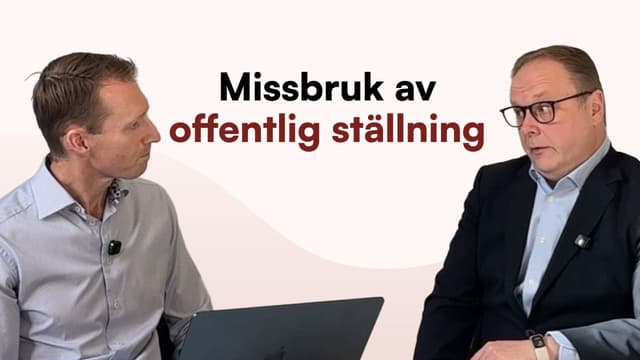
The New Official Liability – What Does It Mean for Whistleblower Handling?

The Swedish debate surrounding public employees' accountability for their actions in office has been discussed for a long time. Now, a variation of official liability (tjänstemannaansvar) has been reintroduced. Here, we outline what it looks like, who is covered, and how it impacts anti-corruption efforts and the handling of whistleblower cases. On August 1, 2026, the offence Abuse of Public Position(Missbruk av offentlig ställning) was introduced into the Swedish Penal Code (brottsbalken). The new rules make it a criminal offence to intentionally, and in violation of the law, favor or disfavor anyone. Criminal liability during the exercise of duty in public operations is also significantly expanded. ## Who and What Are Covered? Under the new rules, actions taking place during the performance of public duty, a public assignment, or other public operations are covered. This means that everyone working in public operations or holding a public assignment is subject to the legislation – whether the work is state, regional, municipal, or carried out within a private company. Employees, elected officials, and privately employed individuals performing publicly funded tasks are therefore covered by the legislation. Furthermore, the rules are not limited to the exercise of public authority (myndighetsutövning), but encompass the performance of duty in its entirety. ## Penalties The previous rules on official misconduct (tjänstefel) remain in a revised form. Those rules do not affect elected officials, and minor misconduct cannot lead to a conviction. In the rules for abuse of public position, there is no equivalent to minor misconduct; instead, a distinction is made only between the "standard degree" and "gross abuse of public position," the latter carrying a sentencing scale from 18 months to 6 years in prison. Gross offenses typically involve a particularly responsible position, significant values concerning damage or gain, organized crime, or particularly dangerous acts. ## Background The previous legislation on official misconduct was widely debated, primarily because it was limited to the exercise of public authority. One effect was that the mismanagement of public funds was not punishable, as it was not considered linked to the exercise of public authority. Procurement and purchasing were also usually excluded from the legislation, meaning that criminal liability for official misconduct did not cover improper support to individual business operators or intentional favoring of a specific party in a procurement process. In individual cases, there were also no consequences for elected officials who refused to comply with the law or court decisions. The new rules aim, among other things, to address problems of these and similar types. Of particular note is that the scope of the rules has been expanded to include elected officials and private employees in publicly funded activities. ## What Applies to Whistleblower Handling? In connection with the investigation of whistleblower cases, the new legislation will have significant relevance since more types of conduct will be punishable by law. For a report to be considered a whistleblower case within the meaning of the law, the misconduct must be serious and there must be a public interest in its detection and investigation. Misconduct constituting criminal activity under the Penal Code generally carries a high public interest, meaning a larger share of reports will satisfy these criteria. As an example, a buyer's improper disfavoring of a specific supplier in procurement is now a criminal act that should be investigated as a whistleblower case. At the same time, there is a new layer of complexity regarding the investigation of whistleblower cases, as one must account for a potential police investigation into the same matter. For instance, interviewing a suspect in such a case may often become directly inappropriate, as it risks interfering with the police investigation. Other examples of misconduct that, with Abuse of Public Position, will be judged more strictly and fall within the scope of the Whistleblower Act include cases where civil servants or elected representatives favor or disfavor someone. Favoring or disfavoring someone can manifest in many different ways, including when an official ignores a court decision and thereby produces a positive or negative effect for an individual. ## Private Operations The offence Abuse of Public Position may appear to be a matter specifically for the public sector, but private companies can also be affected. This applies to entities funded by public means, such as independent schools, vehicle inspection centers, or consultants working for public operations. Employees in these entities are thus indirectly considered to act in a form of public capacity—an important point to note for the investigative team handling whistleblower cases in such operations. ## Recommendation As with all new legislation, a degree of legal uncertainty remains, but many types of actions will likely need to be evaluated differently moving forward. In any event, it remains to be seen how the courts will rule regarding what constitutes improper favoring or disfavoring. However, there is good reason to review existing procedures now, consider the extent to which the new criminal offence will impact how whistleblower cases are evaluated, and take any necessary measures to adjust the guidelines applied in day-to-day operations.
blog image

October 16, 2026

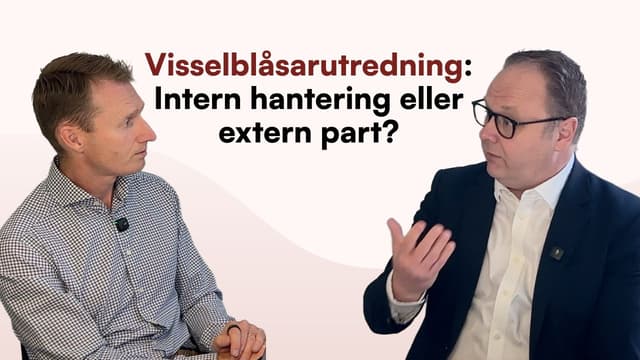
When Should a Whistleblowing Investigation Be Outsourced to an External Party?

Whistleblowing cases vary greatly, and how they should be investigated can be influenced by many factors. External assistance with investigations can become relevant due to various reasons, such as the need for specialist expertise, clearer independence, or to be able to point to an external party when making decisions. In an interview with Joakim Karlén, we discuss how to approach investigative work and engaging external support. Handling an incoming whistleblowing report involves balancing legal protection, good management culture, and personal integrity. The primary purpose of the investigation is to establish the facts: to either confirm or dismiss the allegations made, and to provide the organization with a well-founded basis for decision-making regarding further actions. To ensure high quality in the investigation, methodology, confidentiality, and above all, independence are required. ## The Core of Investigative Work: Independence and Confidentiality Independence is the single most important factor in a whistleblowing investigation. The person conducting the review must be completely neutral in relation to the operations and individuals involved. Furthermore, the process demands strict confidentiality. The investigation must not disclose the whistleblower’s identity, nor should it subject the person under investigation to an unfair or incompetent process. For this reason, most investigations begin with a thorough review of written documentation and factual circumstances before any interviews are conducted. ## When Are Internal Resources Insufficient? Many organizations have competent internal teams that manage cases effectively. However, there are three clear situations where an external party should be involved: **Conflicts of interest and personal ties: **If the report concerns a person in a senior position, or someone close to the internal investigative team, a conflict of interest arises. It is unrealistic to expect complete independence from employees who will continue working together after the investigation is concluded. **Need for specialist expertise: **Some cases are legally complex or require specific expertise in work environment issues and HR. Smaller municipalities or companies lacking in-house legal counsel often need external expertise to ensure the investigation report holds up legally. Need for a confirmed impartial voice: Sometimes the required knowledge exists internally, but the organization needs an entirely independent statement to rely on. This provides management with a secure and objective foundation for difficult decisions. ## Psychological Benefits and Signal Value An external investigator enters the situation without history within the organization. This often reduces the defensiveness that can arise when employees are examined by their own colleagues. The interview setting becomes less tense, which facilitates the collection of facts. Finally, one should be mindful of the signal value in working with external, independent investigators. By establishing clear principles for when external investigators are engaged, the organization demonstrates—to both employees and the outside world—that misconduct is taken with the utmost seriousness and that complex investigations are not avoided.
blog image

September 7, 2026

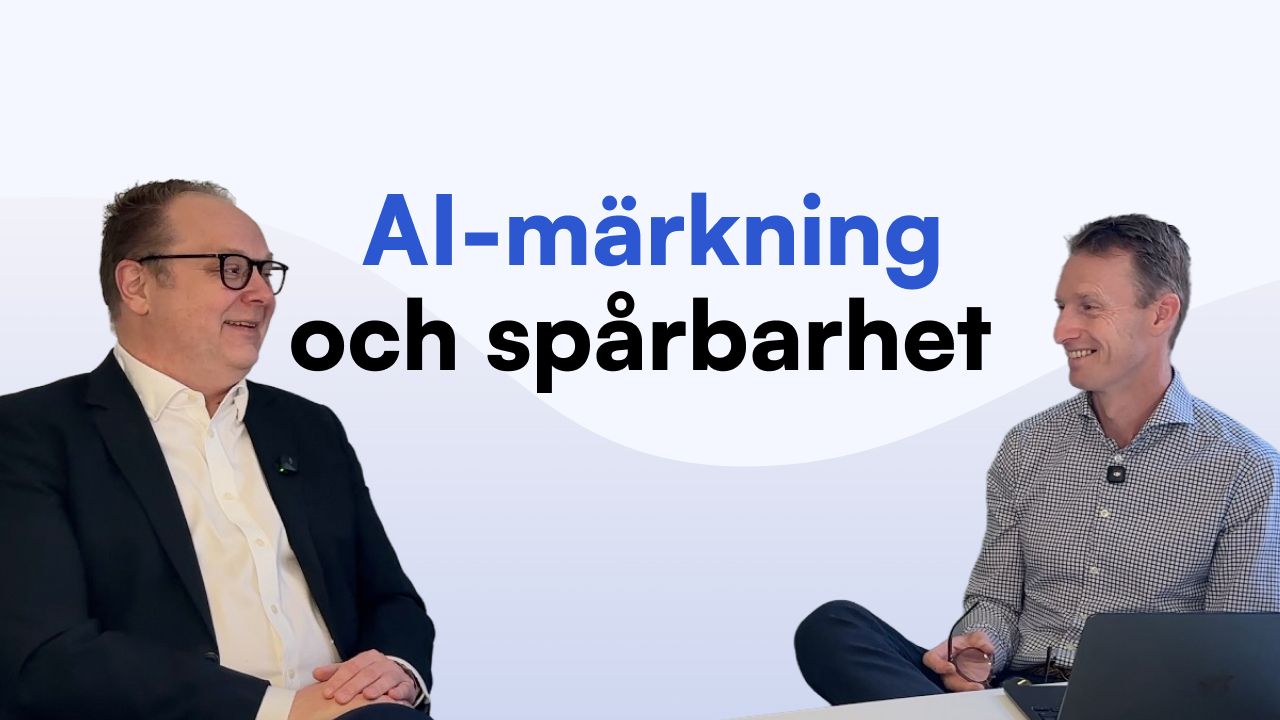
Labeling and Traceability of AI-Generated Material: What Do the New Requirements Entail?

In an interview with Joakim Karlén, we discuss new requirements for AI-generated material, primarily various types of labeling. The discussion stems from the new regulations that recently came into force as a result of the AI Act. ## New Requirements The EU AI Act and its new transparency requirements place higher demands on how AI-generated material must be handled and labeled. For many organizations, the new rules raise questions regarding what responsibility actually lies with them—whether as a developer, employer, or individual publisher. The transparency rules in the EU AI Act have now entered into force, two years after the legislation's original adoption. This means that all organizations that develop or deploy AI systems need to comply with clear requirements for labeling and traceability. ## Types of Labeling Labeling of AI-generated content can broadly be divided into two categories: Overt labeling: Clearly visible information for the viewer, such as a watermark on an image stating "AI-generated" or plain text in a document's metadata. Technical (invisible) labeling: Mathematical or statistical shifts in the material, such as SynthID. It is not visible to the human eye at first glance, but can be identified by digital detection tools. ## Who Bears the Responsibility? It is important to distinguish where the responsibility lies in the chain. Creators of AI models (such as OpenAI, Anthropic, and Google) are required to build traceability and labeling directly into the technology. For companies that purchase or deploy these tools for their employees, the same general requirements for automatic labeling do not apply—with important exceptions. When publishing deceptive material, such as deepfakes or completely unmoderated texts, an obligation arises to inform the recipient. If, on the other hand, text or images have been reviewed, edited, or processed by a human prior to publication, an explicit warning is generally not required. As AI tools become a natural part of daily work—much like earlier technologies such as spell check—the need for major adjustments diminishes. The key for companies is to establish clear internal principles for communication and transparency. By proactively clarifying how AI is used in the organization, ambiguities are avoided and trust among customers and the public is maintained.
Image describing Simplicity

Simplicity

Simplicity is the guiding principle in all of Lantero's solutions. The regulations and requirements we work with are often complex, which makes it especially important that processes, forms and templates are clear and understandable.

The functionality is tailored to the customer's needs, to create a purposeful solution without unnecessary complexity.

Image describing Personal commitment

Personal commitment

Lantero's philosophy is that complex regulations should be managed with a combination of simple digital tools and personal support when needed.

We are here to support everything from questions about the specific regulation to questions about the process or practices in a certain area.

Image describing Network of experts

Network of experts

We know from experience that expertise from specialist often is necessary. Therefore, to provide comprehensive support, Lantero offers a network of lawyers and other experts.

We ensure that the customer receives the right advisors based on current needs and that the assignment is clearly defined to create predictability in delivery and cost.

What do our customer think?

Lantero is always easy to get hold of when you have questions about a case and I like that we can always get support.

Gabriella Demirci

Coordinator of the whistleblower function, Botkyrka municipality
We are very happy with the service that Lantero has given us from the very beginning, all the way from support regarding the whistleblowing process to detailed questions regarding individual cases. Lantero is always available and respond quickly, relevantly, and educationally, even at non-working hours, with great customer-focused commitment. It makes it both safe and convenient for us to have this support from Lantero.

Jakob Söderbaum

Data Protection Officer, Huddinge municipality
Lantero's whole approach feels serious and well thought out, it suits us.

Monika Sundesson

Head of HR, Barncancerfonden
Even before the new law, we were looking for different possibilities of integrating whistleblowing into our code of conduct. We found Lantero to be simple, clear and it was especially good with an independent party that was not connected to other governance functions or collaborators within the company. Everything has worked smoothly, and the tool is simple to handle if cases come.

Josefin Sollander

Chief Communications Officer, Soltech Energy Sweden AB
I appreciate Lantero's care and pragmatism.

Niklas Nordh

General Counsel, Cabonline
Lantero's service is the most thorough in the industry with consistently high quality at all levels. It was also very easy to implement the process. We work with recruitment and consultants in finance, such as CFOs, controllers, and accounting economists, and the trust that an independent whistleblowing channel creates becomes an advantage in the relationship with customers as well as candidates.

Peter Bergmark

VD, Vindex AB

Read more about our services

Book a demo for a service!

Questions? Contact us