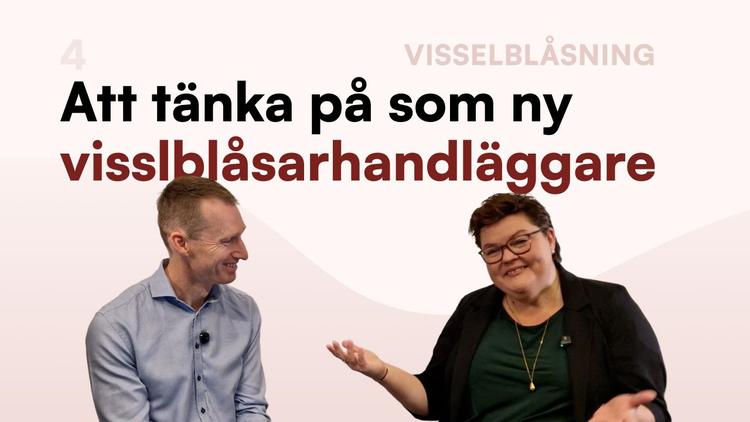
What to Consider as a New Whistleblowing Case Handler
Published: January 20, 2026
Last Updated: January 20, 2026
Below is a lightly edited version of an interview (in Swedish) we conducted with Sara Johansson, who works with whistleblowing assessments at Lantero. We asked her what new case officers need to keep in mind when they start handling whistleblowing cases, what types of situations they may encounter, and which common pitfalls to watch out for.
Interviewer: When someone steps into a role as a new case officer in a municipality and begins working with the whistleblowing function, what should they keep in mind or expect?
Sara Johansson: You’ll need to find a way to separate the wheat from the chaff, because many of the reports you receive are not, in fact, whistleblowing cases. They may involve an employee having issues with their manager, comments on organisational efficiency, or opinions on how things are structured. These are typically not whistleblowing matters.
Then there are cases where there is actually something to look into. In those situations, you need to determine whether the reporting individual belongs to the protected group under the legislation, and whether the report concerns a public-interest wrongdoing. This might involve signs of corruption, serious conflicts of interest, or questionable recruitment processes carried out without proper advertising. In some types of operations, there may also be risks to patient safety or collaboration difficulties in critical environments. The key is to identify and distinguish these cases from the rest.
Interviewer: There is a lot of legislation underlying this work, and case officers need to apply it in their assessments. And in many organisations—especially smaller ones—actual cases are infrequent. How should one stay up to date on these issues?
Sara Johansson: One challenge is that there are very few court decisions in this area, which means there's not much case law to rely on. My recommendation is therefore to read everything that is published: follow relevant accounts on LinkedIn—ours, for example—and stay updated on news reporting around the topic.
At the same time, you need to keep in mind that there is a clear sequence for handling these cases: there must be a wrongdoing, and it must concern a group defined as the public.
Interviewer: And if someone has questions?
Sara Johansson: Then they contact Lantero.
Interviewer: Do you have an example of a situation that may arise—something many case officers will encounter early on?
Sara Johansson: Do you want an example of a case that isn’t a whistleblowing matter? Because most cases are not.
Interviewer: Yes, describe that type of case.
Sara Johansson: The most common goes something like: “You have to do something. We can’t take it anymore. Our manager has completely lost control.” Then follows a long description of everything that is not working. This is by far the most common scenario.
Interviewer: And what is your advice to the client in that situation?
Sara Johansson: My advice is to explain that this is not a serious wrongdoing under the law, but something that needs to be addressed through another process. Often, you raise it within the organisation as a tip—an indication that the organisation should take a closer look at how the work environment is functioning—rather than treating it as a whistleblowing case.
Interviewer: If you have further thoughts or questions on this topic, you are very welcome to contact us. Otherwise, we wish you the best of luck—and thank you for watching.